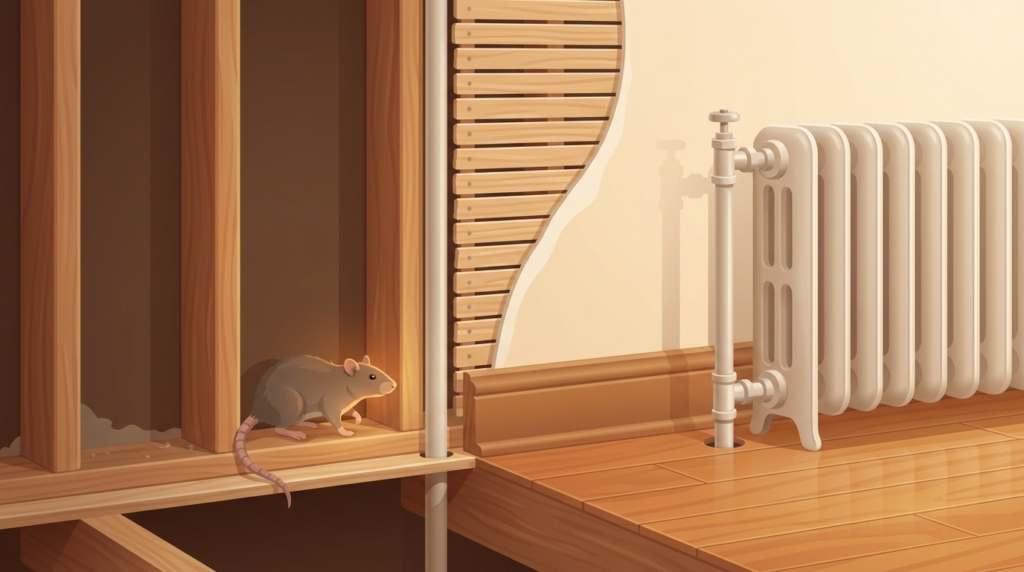
Rats end up inside Manhattan apartment walls because a wall gives them shelter close to food, and in an apartment building, the space inside your walls is part of the whole building, not just your apartment. Cornell University’s Integrated Pest Management program (Cornell IPM) says on its page about mouse and rat biology and behavior that Norway rats prefer to burrow in soil, but will take advantage of voids near a food source. So what should you do if you hear one? Don’t put poison in the wall. Note when and where you hear it, and tell your landlord or managing agent, because the wall, the space inside it and the way in are all part of the building.
Below, we take each question in turn: what the noise is, how long a rat stays, what it’s doing in there, why poison backfires, what to do about the smell and when the building should call in a pro. If you’d rather hand the problem to someone else, start with our page on rat removal.
Hearing rats in your Manhattan apartment walls?
Our technicians show up in uniform and put booties on before they come through your door.
Why Do Rats End Up Inside Manhattan Apartment Walls?
Because the inside of a wall is shelter, and an apartment building keeps a lot of shelter close to a lot of food. It stacks homes, and their kitchens, above and beside one another, with hollow walls, floors and ceilings in between, which repeats the void-near-food arrangement floor after floor.
Where in the building the rat shows up tells you something, too. UC IPM, the University of California’s integrated pest management program, says in its Pest Note on rats that when Norway rats invade buildings, they usually dwell in the basement and ground floor areas, though infestations within ceiling voids are not uncommon. A rat in a basement or ground-floor apartment fits that picture. A rat in a wall several floors up has made its way well above those floors, which makes it the building’s problem, not just yours.
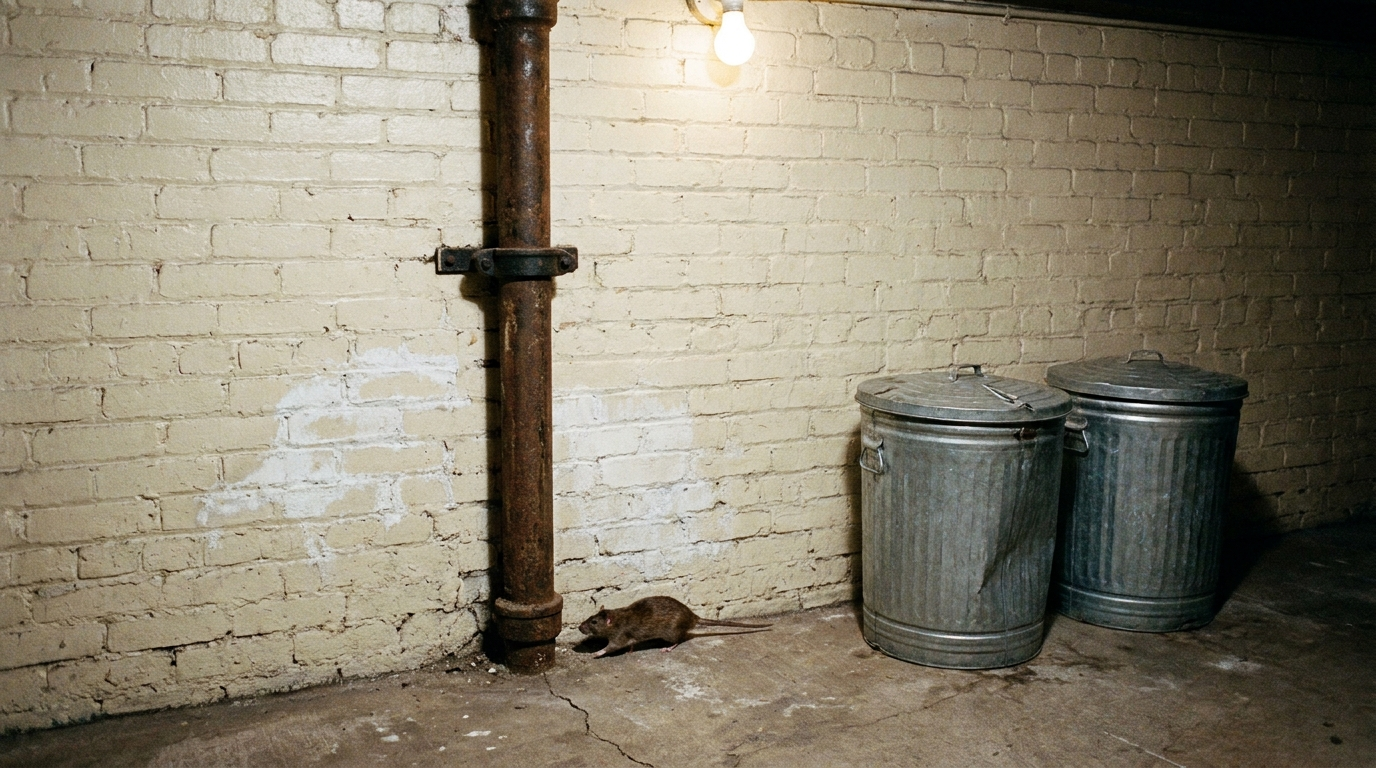
Why would there be rats in your walls but not in your apartment? Because a rat can live in the wall and eat somewhere else. UC IPM’s Pest Note says the nightly foraging ranges of Norway rats vary significantly with local conditions and may be anywhere from 100 to 500 feet from their nests. In an apartment building, a trip that long can take in the basement, the garbage and other people’s kitchens, so you can hear a rat in your wall without ever seeing it in your rooms. For example, a rat nesting in the wall behind your kitchen cabinets could be making its nightly run to the building’s garbage downstairs rather than to your kitchen.
How rats get from the basement into the walls of the floors above, by way of the pipes and shafts that run up through older buildings, is covered in our guide to the walk-up and airshaft routes rats use.
Is That Scratching Behind the Wall a Rat, a Mouse or a Squirrel in Manhattan?
The sound alone won’t tell you. When you hear it and where you are in the building narrow it down, and what the animal leaves behind tells a rat from a mouse.
Start with the clock. UC IPM’s Pest Note says rats are mostly active at night. UC IPM’s page on tree squirrels says tree squirrels are active during the day and most active in early morning and late afternoon. So scratching in the daytime is more likely a tree squirrel than a rat, and scratching after dark fits a rat or a mouse.
Then think about where you are. In a Manhattan building, the floor you live on is a clue in itself, for the reason in the section above. Squirrels come in from outside, and UC IPM’s squirrel page says they may invade attics through gaps or broken vent screens, so noise in a top-floor ceiling, under the roof, belongs on the squirrel side of the list. For example, scratching over a top-floor bedroom in the middle of the afternoon leans toward a squirrel, while scratching inside a kitchen wall near the ground floor late at night leans toward a rat or a mouse.
To tell a rat from a mouse, look rather than listen. Check along the bottom of the wall where you hear it, and under the sink and in the lower cabinets on that side, for droppings, without touching anything. Then compare what you find with our guide to telling rat droppings from mouse droppings. If it turns out to be mice, the job is a different one, and our guide to getting mice out of the walls covers it.
If everything points to a squirrel, we’re not the call: squirrels aren’t on the list of pests we treat. Tell your landlord or managing agent, because the animal is getting in through the building’s outside wall or roof.
How Long Will a Rat Stay Inside a Wall Before It Moves On?
There’s no set time. A rat doesn’t stay in a wall for a fixed number of days and then leave; it tends to stay for as long as the wall keeps working as a home. UC IPM’s Pest Note says that when food sources and nests are close together, rats usually stay as close to their nests as possible to reduce risks of predation and other dangers. A wall with food somewhere in the building is that arrangement.
That’s why cleaning up your own kitchen, worth doing as it is, may not be enough to move a rat on in a Manhattan apartment building. If the rat is eating in the basement, the garbage room or someone else’s apartment, its food supply isn’t yours to cut off.
Waiting has a cost, too. UC IPM says the average female Norway rat has 4 to 6 litters per year and can successfully wean 20 or more offspring annually, so time is on the rats’ side, not yours.
And if the scratching stops, that isn’t proof the rat moved out. Quiet can mean it’s using another stretch of the building, or that it has died inside the wall, which the sections on poison and smell below deal with.
What gets a rat out of a wall isn’t time. It’s the step-by-step approach in our guide to getting rid of rats in an apartment.
What Do Rats Do Inside the Walls of Manhattan Pre-War Buildings?
They live there. Inside the wall, a rat travels, nests, gnaws and leaves urine and droppings, and the signs show up where the wall meets your apartment. UC IPM’s Pest Note lists the damage rats do to buildings: gnawing on electrical wires and wooden structures such as doors, ledges, corners and wall trimmings, and shredding insulating materials in walls and ceilings for use in their nests.
In a pre-war building that still has its original walls, there’s a particular reason to care about the gnawing. The National Park Service’s preservation brief on repairing historic flat plaster names three types of lath found in historic buildings, wood among them, and describes wood lath as narrow, thin strips of wood with spaces in between, nailed across the joists and studs or fastened to furring strips to hold the plaster in place. So the wall behind old plaster can be partly wood, which rats gnaw, and the pipes for radiators and plumbing pass through those walls and floors.
UC IPM adds a warning that matters in any building with gas: rats may even chew directly on natural gas lines, creating explosions and fire hazards. That isn’t a reason to panic at every noise. It is a reason not to let rats in the walls go on living there.
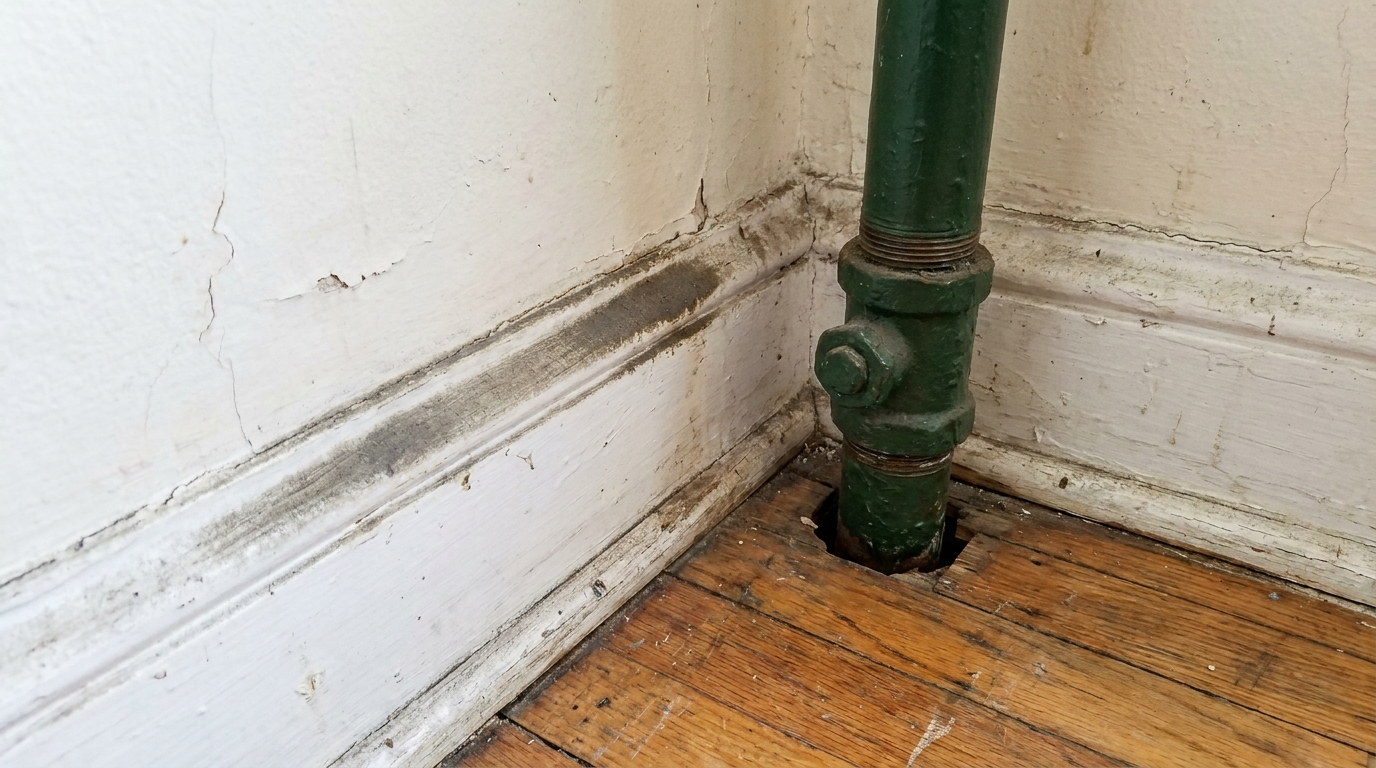
The signs you can see are at the edges of the wall: droppings along the baseboard, gnawed wood at the bottom of a door or around a hole, and dark, greasy smudges. UC IPM lists smudge marks caused by rats rubbing their fur against beams, rafters, pipes and walls among the signs that you may have a rat problem, so a dark ring where a pipe comes out of the wall or floor is worth a closer look.
Rats in the walls of your Manhattan building?
Every technician is licensed by New York State. After the visit you get a service report and a warranty call.
Why Is Poison in the Walls the Wrong Fix for Manhattan Renters?
Because poison doesn’t send a rat out of the building to die. Cornell IPM’s guide to managing mice and rats answers the idea that poisoned rodents go outside looking for water: it says feeding on baits does not cause rodents to leave the home in search of water. Instead, they tire and look for protected areas, and their death inside walls and other voids produces a smell that can last for days for mice and weeks for rats. If a rat has been living in your wall, the wall is the protected place it already knows.
For a renter, that’s the problem in a sentence. A dead rat inside a plaster wall is one nobody can reach without opening the wall, and in a rental, opening a wall goes through your landlord. Until then, you live with the smell.
There’s a second reason in an apartment building: who is allowed to put rat bait down at all. That’s a legal question with its own answer, set out in our guide to who may legally put down rat bait in an apartment building.
So if you rent and you hear rats in a wall, skip the poison. Report it to the building, as the section on calling a pro explains, and leave what goes into the walls to the owner and the licensed professional the owner hires.
How Do You Deal With a Dead Rat Smell Inside a Wall in Manhattan?
Find where the smell is strongest. If you can reach the rat, don’t touch it with bare hands: the dead rodent section of How to Clean Up After Rodents, a page from the Centers for Disease Control and Prevention, starts with rubber or plastic gloves, so follow that section step by step. If you can’t reach it, decide with the building whether to wait it out or open the wall. The smell doesn’t last forever: Cornell’s range, from the section above, is that it can last weeks for a rat and days for a mouse, and our guide to a dead mouse smell in a wall covers the mouse case.
Waiting has a cost the smell doesn’t tell you about. The same Cornell guide says dead rodents that are not removed can attract later-stage decomposers such as carpet beetles and clothes moths, which feed on the hair and skin of rodent carcasses and eventually on wool rugs and clothing.
Before anyone opens anything, narrow it down by smell: which room, which wall and how high. Check the places you can get into without moving appliances or opening the wall, like under the sink and inside the lower cabinets, and look without touching anything, because a rat that died there won’t need a wall opened. For example, if the smell is strongest low on the kitchen wall behind the sink, the sink cabinet is the first place to look, still without touching anything, before anyone talks about opening plaster. If you find the rat there, put on rubber or plastic gloves before you touch it, then follow the CDC’s dead rodent steps linked above, in order.
If it’s inside the wall, the choice belongs to whoever owns the wall. In a rental, tell your landlord or managing agent where the smell is strongest, so the decision to open the wall, and where, is made with the most information. In a pre-war building, opening original plaster means repairing it afterward, which is why it’s a decision for the building rather than a quick fix you make yourself.
When Should a Manhattan Landlord Call a Pro About Rats in the Walls?
When the building has rats. That’s the trigger in NYC Health’s booklet for property owners and managers, Preventing Rats on Your Property, which starts with what to do if you have rats on your property: follow the guide and hire a pest control company. Its booklet for residents, How to Control Pests Safely, puts it the same way from inside the apartment: if you have rats in your home, you need a pest control professional, and it says to be sure the professional is certified by the New York State Department of Environmental Conservation (NYS DEC).
Who makes the call depends on who you are. If you rent, the residents’ booklet says the owner is required to keep your home pest-free and must hire a professional if necessary, and it tells you to tell the owner immediately if there are pests in your home. So the tenant’s part is the report, and the owner’s part, directly or through a managing agent, is the call. In a co-op or condo, start with the managing agent.
A report the building can act on names the room, the wall, the time of day you hear it, and anything you’ve seen, such as droppings, rub marks or a smell. For example: scratching inside the bedroom wall next to the stairwell most nights after the lights go off, droppings under the kitchen sink, and the neighbor upstairs hears it too. Rats in one apartment’s walls can be using walls that run past the neighbors’ as well, so ask the people above, below and beside you whether they’re hearing it, and mention it when you report.
For owners, the owners’ booklet looks past your own walls: if your building has rats, nearby buildings may as well, and it suggests you consider working with your neighbors to hire the same pest control company.
If the owner doesn’t act, how a 311 complaint works and what an owner must do are covered in our guide to a landlord’s duties on rats and how 311 works. If you own the building and want to know what the work tends to cost, see our breakdown of rat exterminator costs in NYC. And if you manage a Manhattan building, our pages on rodent control in Manhattan and rodent control are the place to start.
Final Thoughts
Rats end up in Manhattan apartment walls because a wall is shelter close to food, and a rat several floors up is a sign the problem runs through the building, not just your apartment. It isn’t likely to move on by itself while the building feeds it, and poison in the wall can leave you with a dead rat inside it and a smell that can last for weeks. The fix starts with a clear report to whoever owns the wall, and in a rental, NYC Health’s residents’ booklet says the owner must hire a professional if necessary.
We treat rats, and we cover all five boroughs. If roaches, mice or bed bugs are part of the same building’s problem, see our page on pest control in Manhattan.