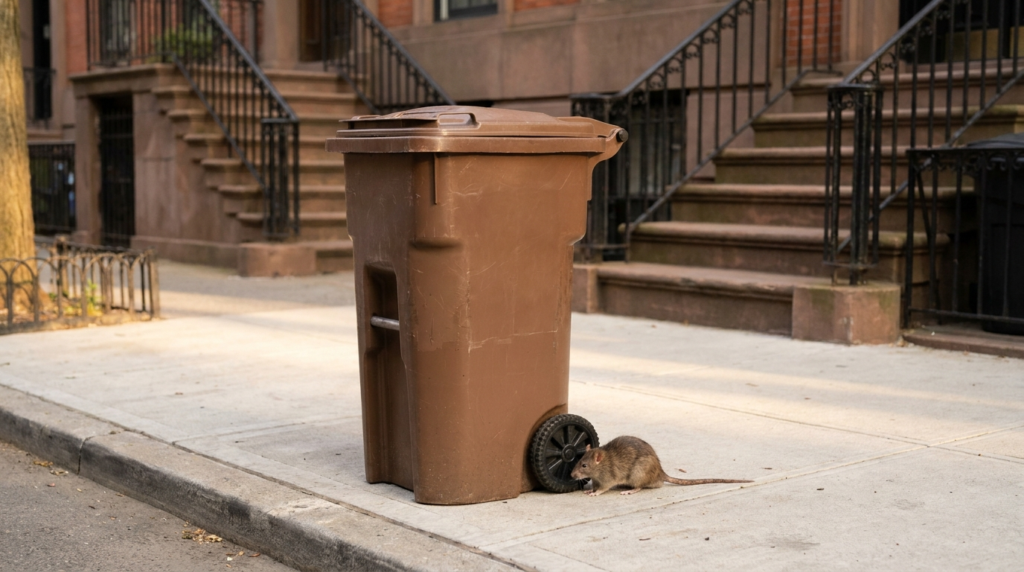
Not when your food scraps go into a bin with a secure lid and stay there, which is what NYC’s composting rule asks for. Rats come for food they can reach. As NYC Health puts it, “Any exposed garbage will attract rats.” The risk is in how a bin gets used: a bag left on the curb, a lid propped open, a bin too full to close. If rats have already moved in around your building’s bins, fix the bins first, then bring in professional rat removal.
Rats near your NYC compost bin?
Every technician is licensed by New York State.
Do Lidded Compost Bins Keep Rats Away From NYC Homes?
Yes, as long as the lid stays shut and the scraps stay inside. During the city’s early composting pilot, NYC Health inspectors found no gnaw marks, no droppings and no new rat burrows around any bin they checked. The Department of Sanitation (DSNY) published that finding in its 2015 organics collection report.
The pilot gave every participant a locking, hard-sided brown bin, and it focused on small buildings of one to nine units. The report is also DSNY’s own, about its own program. Today the rule accepts your own labeled, lidded bin too. DSNY’s flyer says putting scraps in bins with secure lids keeps rats out. Its FAQ adds that a bin cuts the chance of a bag splitting open on the curb and drawing pests.
A lidded bin lined with a clear plastic bag smells no worse than the same scraps in the trash, DSNY says.
What Does NYC’s Composting Rule Require From Every Household?
Every household has to keep food scraps, food-soiled paper and yard waste out of the trash. DSNY’s rule covers every NYC resident, whatever the size of the building, and DSNY picks up compost every week on your recycling day.
You don’t need a city-issued bin, but yours has to meet two rules:
- Use any labeled bin with a secure lid that holds 55 gallons or less, or a DSNY brown bin, per NYC311’s curbside composting page. DSNY no longer hands out free brown bins to first-time residents.
- Label it. NYC311 takes orders for a free composting bin decal, and DSNY has a label you can print.
The list of what goes in is broader than backyard compost advice allows. DSNY takes every kind of food scrap, including meat, bones, shells and dairy, plus prepared and cooked food. Greasy uncoated paper plates and pizza boxes go in too, along with certified compostable products and leaf and yard waste. What stays out: wrappers, diapers, pet waste, medical waste, foam and personal hygiene products, plus anything recyclable.
DSNY requires the owner or manager of a building with 4 or more units to set aside a storage area with clearly labeled compost bins. If you rent and your building has none, start with your landlord, managing agent or super. If that goes nowhere, you can report a building with no compost storage area, or with too few cans or lids, to 311. For too few cans or lids, HPD (the city’s Department of Housing Preservation and Development) investigates and can issue violations to the owner. Public housing (NYCHA) residents should contact their building super, per DSNY.
How Should You Set Out Food Scraps So NYC Rats Can’t Get Them?
Keep every scrap sealed from your kitchen to the truck. Inside your home, any bag or container can hold scraps until you empty it into the building’s bin. From there:
- Drain liquids before scraps go in. DSNY suggests a layer of paper or baking soda in the bottom to soak up extra moisture.
- Line the bin with a clear plastic bag, a paper bag or a compostable bag. NYC311 says black plastic bags are not allowed, and small bags of daily scraps can go inside the liner.
- Close the lid tightly after every use, as DSNY’s FAQ asks.
- Between pickups, NYC311 says you can keep scraps in the freezer to prevent odors.
- NYC311 says to set a bin out after 6 PM the night before collection, with everything out by midnight.
Tie the liner closed before the bin goes to the curb, and keep food scraps in the bin. DSNY’s flyer says not to put bags of food waste directly on the curb. Bags on their own are only for leaf and yard waste, which NYC311 says can go out after 8 PM.
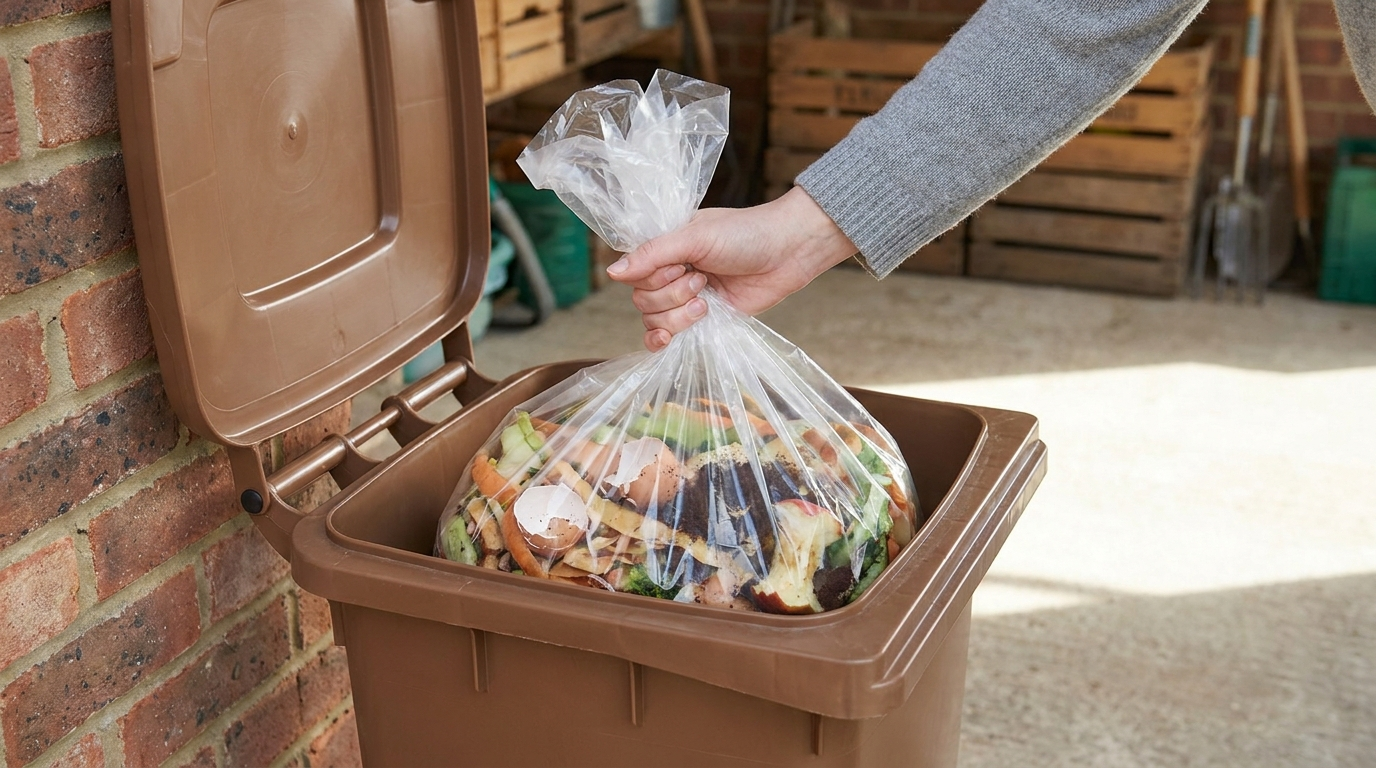
Don’t overfill the bin. DSNY’s collection rules say you must be able to close lids securely to keep pests out. You should also have enough bins for all your trash and compost. For example, say your pickup is Thursday and the bin is full by Monday. A second bin, or the freezer, beats a lid balanced on a bulging bag.
Trash has its own bin rule, which we cover in our guide to signs of rats in Brooklyn. If DSNY misses your compost pickup, you can report the missed collection to NYC311.
Why Can NYC Brown Bins Take Meat When Backyard Compost Can’t?
Because curbside scraps don’t stay in your yard. In a backyard pile, meat, fish, bones, dairy and grease can attract animals, says the federal Environmental Protection Agency (EPA). EPA says backyard piles generally don’t get hot enough to fully break those foods down, but commercial composting facilities can compost them. DSNY’s own Outdoor Composting Guide also tells home composters to keep meat, fish, dairy and grease out of a backyard bin.
The curbside bin is built to stay shut, and it leaves every week. DSNY takes what it collects to processing facilities such as the Staten Island Compost Facility and the digesters at the Newtown Creek Wastewater Treatment Plant. They turn it into fertilizer and biogas.
So meat is no less tempting to a rat at the curb. The difference is that it sits sealed in a bin until the truck takes it, not in a pile in your yard.
A backyard pile can also become a home, not just a meal. Where rats are a problem, DSNY’s outdoor guide tells home composters to turn the material regularly to prevent nesting. It also suggests hardware cloth over any gap an animal could squeeze through. Our guide to getting rid of rats in a Queens backyard covers yard bins and burrows.
Seeing rats by the bins at your NYC building?
Call us and a real person answers.
Can NYC Property Owners Be Fined for Skipping the Composting Rule?
Yes. As of April 1, 2025, DSNY says property owners can be fined if compostable material isn’t separated from trash. NYC311 makes residential property owners responsible for how their building’s waste is set out. NYC311’s fine schedule depends on the violation and, for separation, on the building’s size:
| Violation | First offense | Second offense | Third and later |
|---|---|---|---|
| Compost not separated, building with 1 to 8 units | $25 | $50 | $100 |
| Compost not separated, building with 9 or more units | $100 | $200 | $300 |
| Waste set out wrongly, on the wrong day or at the wrong time | $50 | $100 | $200 |
| Broken bin, or waste spilling out | $50 | $100 | $200 |
NYC311 says each violation can bring its own fine, and the amount can climb with each repeat inside a 12-month period. Say a six-unit building is cited three times in that window for mixing scraps into the trash. Under NYC311’s schedule, that’s $25, then $50, then $100.
In April 2025, the first month of fines, DSNY issued 4,259 composting violations, New York City’s Independent Budget Office (IBO) reported in April 2026. Later that month, fines were suspended for buildings with 30 or fewer units, and larger ones were fined only after five warnings, IBO says. For the rest of 2025, IBO found, DSNY issued no more than 40 violations a month. In January and February 2026, DSNY issued 415 composting fines, about 3% of its April 2025 daily rate, per IBO. IBO’s figures stop at February 2026, and it notes the law itself stayed in effect through the pause.
What Should You Do About Rats Around a Compost Bin in New York City?
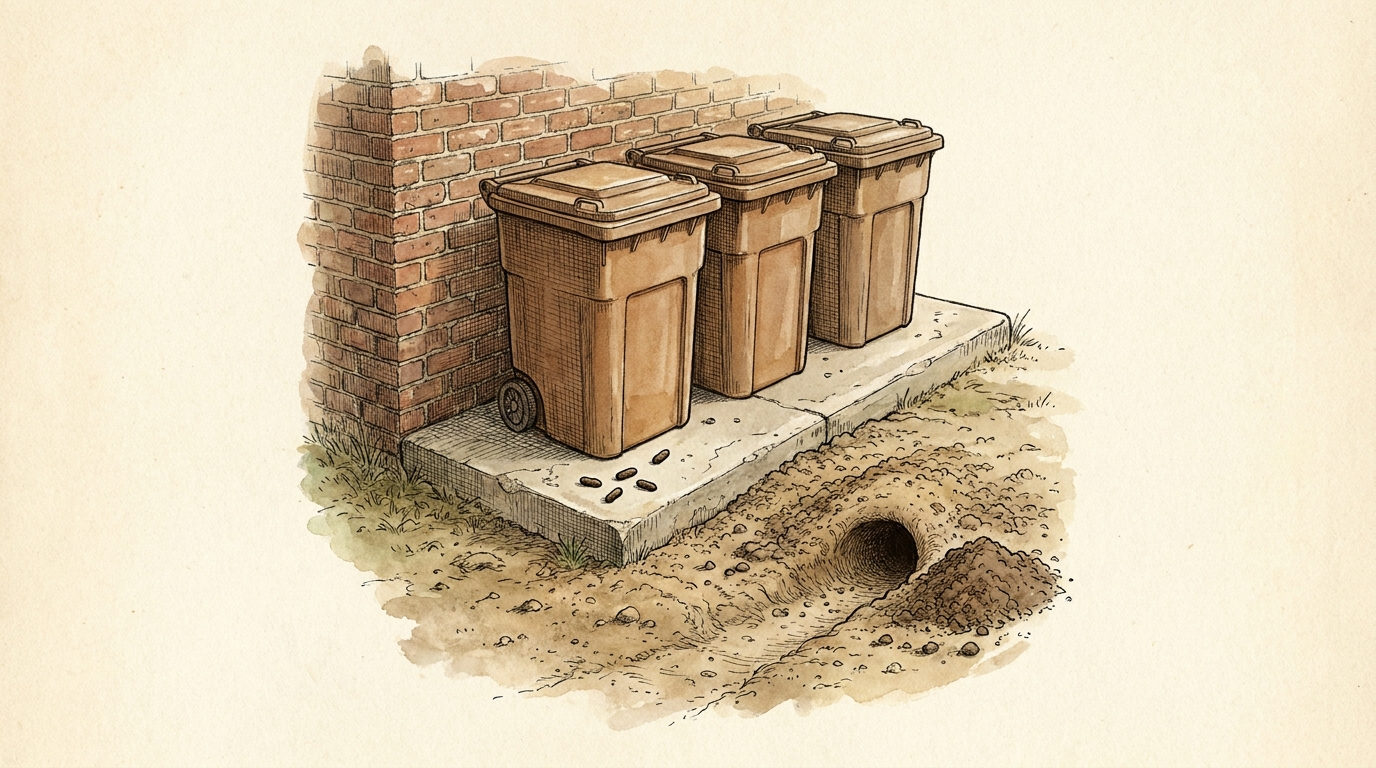
First, confirm it’s rats. NYC Health’s list of signs starts with moist, dark droppings, holes and gnaw marks on garbage cans, and greasy rub marks along walls. It also includes worn paths through grass, burrows in soil, and holes in sidewalks or building foundations. Around a compost bin, check the bin itself, the ground it stands on and any soil nearby. Say there’s a fresh hole in the dirt beside the bins and droppings near the lid. Treat both as signs of rats, and start with the bins.
In NYC, rats on a property are the owner’s legal problem. NYC Health says owners must keep their properties rat-free, fix conditions that lead to rats, and may need to hire a pest management professional.
If you rent, tell the owner, building manager or co-op board first. If nothing happens, call 311 or report it online. NYC311 sends reports of rats inside a home, or in its outdoor areas like yards and alleys, to NYC Health. NYCHA residents use a separate NYCHA maintenance complaint instead.
When NYC Health inspectors find rat activity, the owner gets a commissioner’s order by mail and a follow-up inspection about 10 days later. If conditions aren’t corrected, the owner gets a summons. A summons that isn’t dismissed can lead to fines of $300 to $2,000, according to NYC Health’s rat page for tenants and owners. Our Brooklyn guide walks through filing a 311 rat complaint step by step.
Leave rat poison to a licensed pro. NYC Health says rat poison should be put down by a pest management professional licensed by New York State. In commercial and multi-unit properties, it says owners are required by law to hire a pest management professional. Even in your own home with no tenants, NYC Health recommends leaving the job to professionals.
We treat roaches, mice, rats, bed bugs, ants, termites, bees and wasps, mosquitoes and ticks. For a house or a small building, start with our rodent control service. For a managed building, see property management pest control, and for a Queens address, rodent control in Queens.
The Bottom Line on NYC’s Composting Rule and Rats
A compost bin used the way the rule describes isn’t what draws rats; exposed food is. If droppings, gnaw marks or burrows still show up around the bins once they’re used that way, call us about getting the rats out.