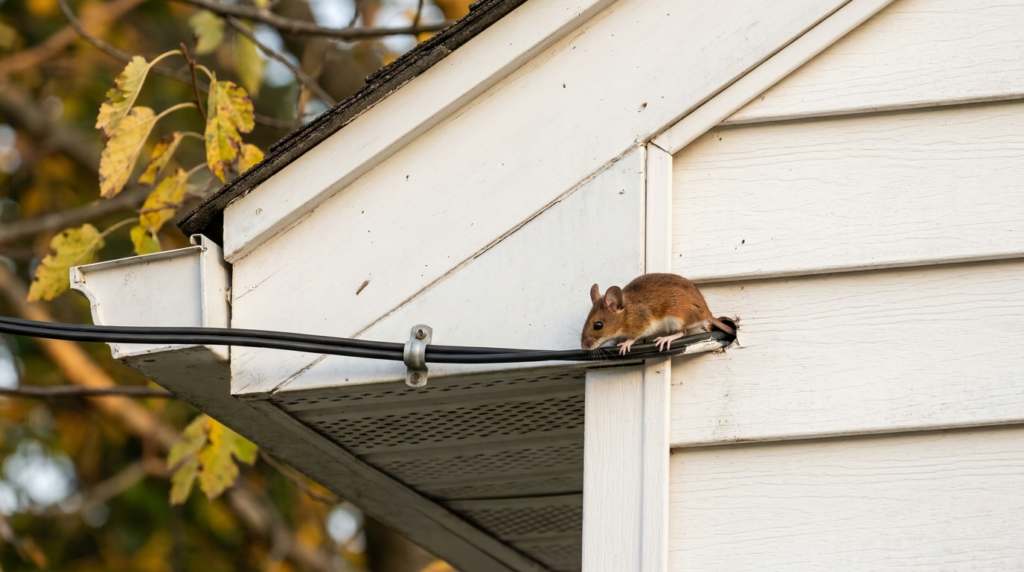
You get mice out of a Long Island attic by doing three jobs together: removing the mice already up there, closing the gaps they use to get in, and deciding whether the insulation they have soiled needs to come out. How long will they stay if you do nothing? Cornell Integrated Pest Management does not give a length of stay. Its page on mouse and rat biology and behavior says white-footed and deer mice spend most of their time outdoors but enter buildings from fall through spring, and that house mice can successfully live their entire lives indoors. So waiting them out is a bet on which mouse you have, and it does nothing about how they got in.
The sections below take those jobs one at a time, from the way mice reach an attic to what keeps them from coming back. If you would rather hand the mouse problem over, start with our rodent control on Long Island. We cover Nassau County and Suffolk County.
Mice staying in your Long Island attic?
Every technician is licensed by New York State, and we waive the inspection fee when you have the work done.
How Do You Remove Mice From a Long Island Attic for Good?
You remove them for good by taking out the mice that are there, closing the way the next ones would come in, and checking that it stays closed. That lines up with Cornell Integrated Pest Management’s page on managing mice and rats, which says rodent management “requires an integrated approach combining multiple tactics,” starting with a detailed inspection to find the source of the problem and identify the rodent, and which sets long-term prevention as the goal, through sanitation and through exclusion, meaning closing the ways in.
Trapping or baiting deals with the mice you have. It does not close the way the next ones come in, which is why “for good” takes the whole list. In practice the list breaks down into the questions the rest of this post answers:
- Where are they getting in? The next section starts there, because the answer changes where you look.
- What have they damaged? Wiring and insulation each get a section.
- Is it mice at all? Attic noise can be a squirrel, and a squirrel needs a different call.
- How do bait stations work up there, and when do they not?
- What keeps the attic closed once it is clear?
Two parts of the job live in other guides. Which traps work, and the method for sealing small cracks and pipe gaps, are covered in our guide to getting rid of mice at home, so this post can stay in the attic. If you would rather not deal with the mice yourself, call us and a real person answers; our mouse exterminator service is the place to start.
Where Do Mice Get Into Attics on Long Island, and How Do You Stop Them?
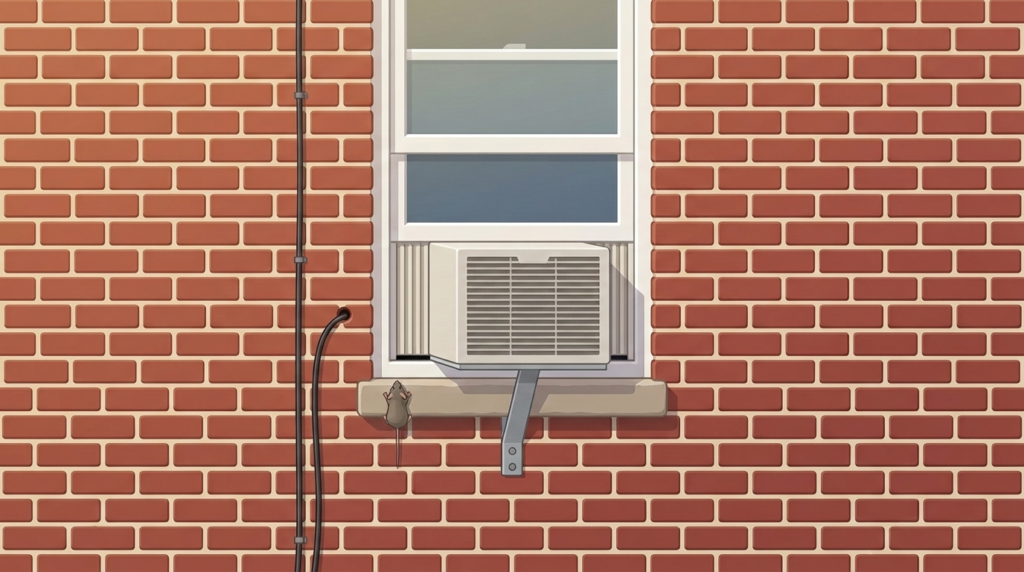
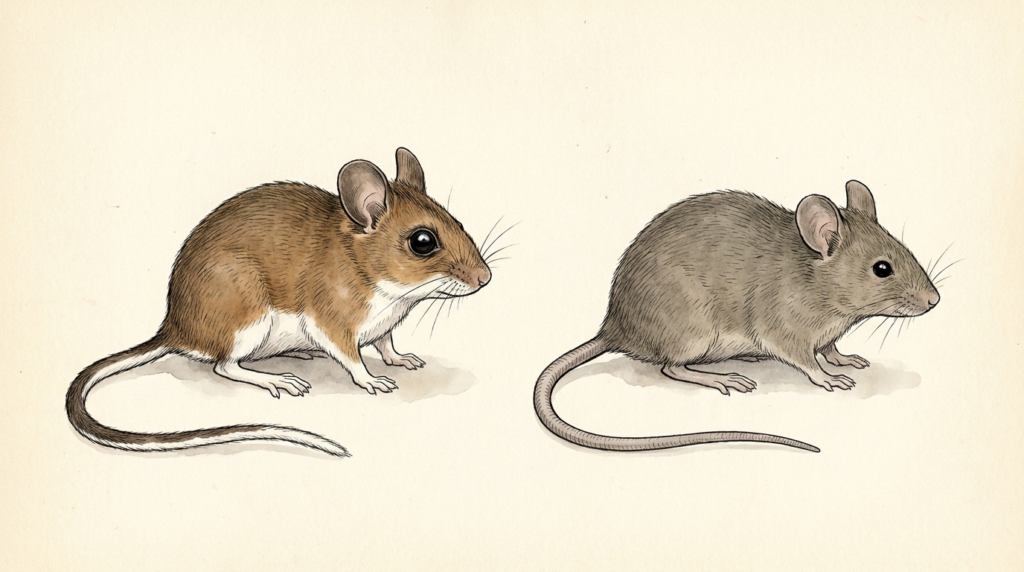
Where they get in depends on which mouse you have. Cornell’s managing page says knowing the species can tell you whether mice are primarily living indoors, as house mice do, or entering from exterior entry points, as white-footed and deer mice do, such as “high up on a building where electrical wires connect, or where tree branches provide a bridge.” Telling the species apart is a question of its own. For the outdoor species, though, those examples point up. On a Long Island house on a wooded lot, that means the places where wires come in high on the house and any limb that touches or hangs over the roof. A house mouse living indoors may be reaching the attic from the floors below, so the rest of the house belongs in the search too.
The roof’s own openings are the other half. Cornell’s pest exclusion page says ridge vents come with end caps that “frequently work loose,” which lets small animals, mice among them, “easily access attics.” It names ventilation openings in soffits, under the eaves, as frequent entry sites, and it says plastic gable louvers should be replaced with metal ones.
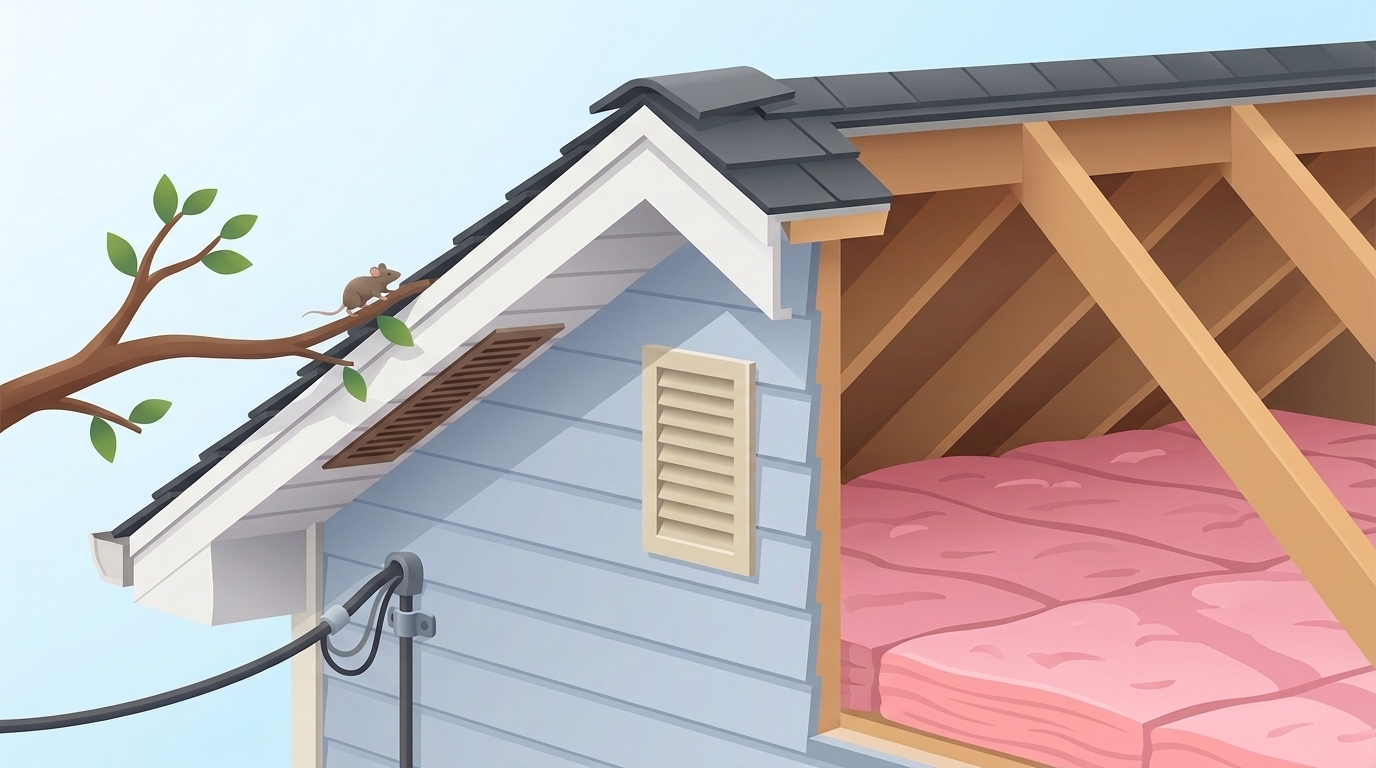
Stopping them starts with two conditions from that exclusion page, and both come before any fix: be certain no animal will be trapped inside when an entry site is closed, since animals living in the building usually need to be removed before exclusion goes ahead (the page explains how to check whether an opening is still in use); and remember that this is outside work at roof height, where snow and ice “make it difficult to safely work on the outside of a building.”
With those two in place, the page’s fixes for the roof’s routes in are these:
- Trim trees back from the roof, which takes away the bridge.
- Secure ridge vents with replacement end caps.
- Protect soffit vents with metal louvers securely attached to the soffit.
- Replace plastic gable louvers with metal ones, with the screening on the back intact.
The page also covers chimneys, dryer vents, sewer vent pipes and exclusion materials, so read it whole before you start. Smaller cracks and the gaps around pipes and wires take a different method, the one in the home guide linked above. And if the roofline is more ladder than you want to take on, we do ladder work and professional pest-proofing and rodent-proofing, and our rodent control on Long Island page, linked at the top of this post, is where to ask about this kind of work.
Can Attic Mice Chew Wiring, and How Do You Prevent the Damage?
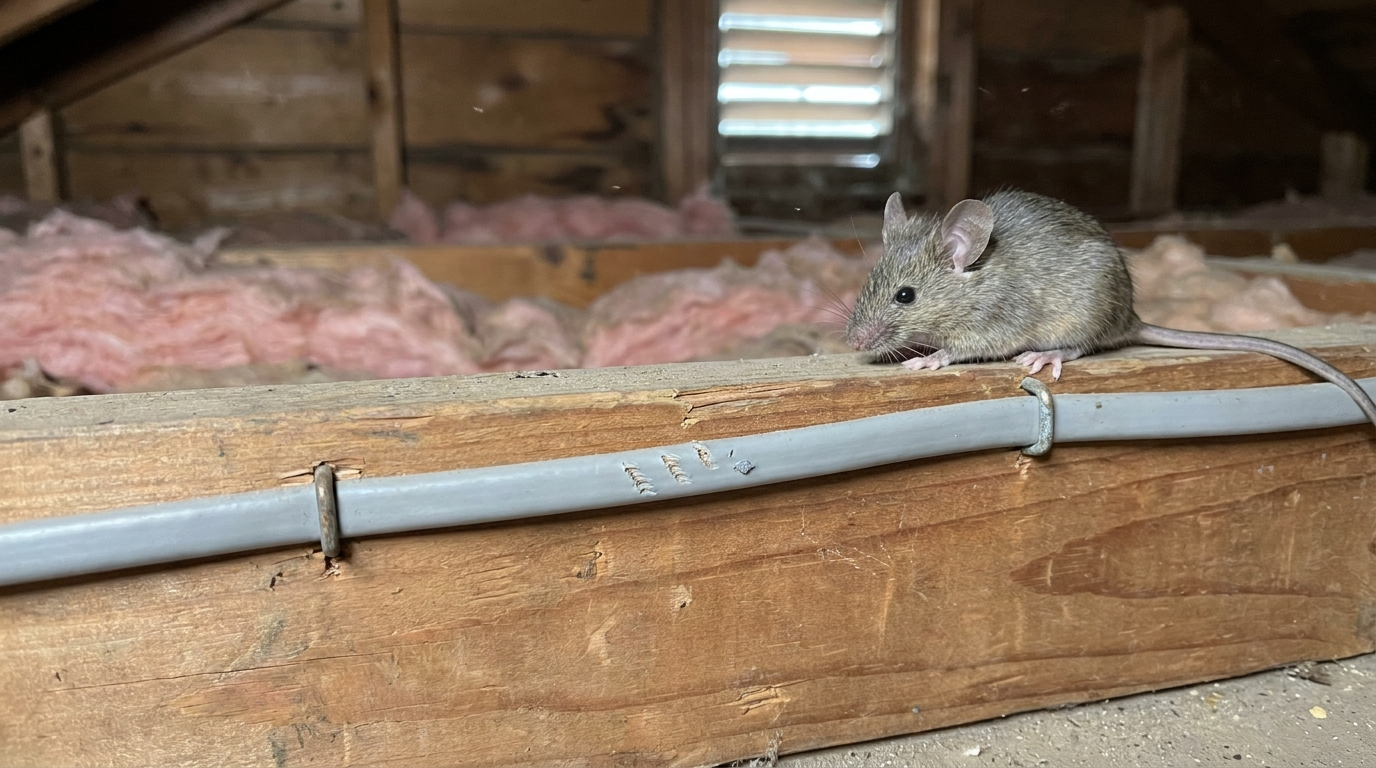
Yes. The University of California’s statewide IPM program, in its Pest Notes on the house mouse, says house mice can damage structures by gnawing on electrical wires, wires in walls included, and that “Many fires of unknown origin are believed to be caused by rodents gnawing on wires.” Note the word “believed.” It is a strong suspicion, not a count, and it is reason enough not to leave mice living near wiring.
Preventing the damage is the rest of this post in short: no mice in the attic and no way back in. Two checks belong on top of that:
- Have an electrician look at any wiring that shows gnaw marks. That repair is electrical work, not pest control, and not something to guess at.
- If your heating or cooling ducts run through the attic, they are part of the question too. CDC’s How to Clean Up After Rodents page says to contact a professional rodent exterminating service to remove rodents when there is evidence they have accessed heating and cooling ventilation systems, and it notes that companies specializing in duct cleaning are familiar with the problems involved.
When Should Mouse-Soiled Attic Insulation Be Removed in Long Island Homes?
When it is exposed and contaminated with urine and droppings. That is the line CDC draws on its How to Clean Up After Rodents page, and the page sets conditions that come before anyone handles it. CDC’s cleanup steps for homes start by opening all doors and windows for 30 minutes to ventilate the space and leaving the area during that time, then putting on rubber or plastic gloves. The page also says not to vacuum or sweep rodent urine, droppings or nesting materials, because diseases are mainly spread to people from rodents when they breathe in contaminated air. Within that same guidance for homes and outbuildings, exposed insulation contaminated with urine and droppings is placed in plastic bags for removal, and the page lists the rest of the steps, from disinfecting to washing gloved hands. Insulation the mice have not reached does not meet that line, so the size of the job depends on how far through the attic the soiling runs.
A heavy infestation is a different job. CDC sets out special precautions for cleaning homes or buildings with heavy rodent infestation, and the protective equipment it lists for the people doing that work includes respiratory protection, with a note to follow local and state requirements on pulmonary function and fit testing before any work that needs a respirator. Work at that level belongs with a contractor equipped for it, such as an insulation or attic remediation company.
If you are getting quotes for it on Long Island, ask each contractor to spell out what the price covers: taking out the soiled insulation, cleaning what is underneath, and putting new insulation back. Prices are hard to compare when one quote covers all three and another covers only the removal.
Two points on timing. Replace insulation after the mice are out and the gaps are closed, so the new layer starts clean. And treat the cleanup as its own job with its own precautions, which the CDC page sets out step by step; our rat vs. mouse guide covers the droppings cleanup and the hantavirus question. If you think a recent illness may be due to a rodent-borne disease, CDC’s advice is to talk to a healthcare provider.
Hearing mice overhead in your Long Island home?
Same-day service during business hours. An emergency means within 24 hours.
Is the Attic Noise Mice or Squirrels, and Who Removes Each in Nassau?
Start with the clock. The New York State Department of Health’s Mouse Control page says you can probably hear mice after dark, because mice are often more active at night. Squirrels mostly keep the opposite hours: the New York State Department of Environmental Conservation’s article on New York’s squirrels, reprinted from its Conservationist magazine, says “Most species of squirrels are active during the daytime.”
The exception is the flying squirrel. The same DEC article says New York is home to two species of flying squirrel and describes them as “largely nocturnal squirrels” that are “most active at night,” though occasionally seen during the day. So daytime noise points to a squirrel, while noise after dark fits mice but does not rule out a flying squirrel.
Whether mice leave the attic at night is a separate question, and the New York State Department of Health’s Mouse Control page does not address it. It says only that mice are often more active at night, which is when you can probably hear them. How long they stay is a different question again, and the top of this post covers what Cornell does and does not say about it. Noise is one clue among several, and droppings, rub marks and the other evidence are in our guide to the signs of mice.
Who removes each in Nassau comes down to the animal. Mice are ours. We treat roaches, mice, rats, bed bugs, ants, termites, bees and wasps, mosquitoes and ticks, and we cover Nassau County and Suffolk County; our rodent control in Nassau County page is the place to start. Squirrels are not on that list.
Squirrels are a job for a Nuisance Wildlife Control Operator, someone holding a license the DEC issues. The DEC’s Nuisance Wildlife Control Operator page says the license authorizes an individual to take or trap, transport and release wildlife whenever the animal becomes a nuisance, destroys property or threatens public safety, and it points anyone with a nuisance wildlife issue to its list of licensed operators to find one nearby. If you hear both, the two jobs can run side by side, but each one goes to the right hands.
How Do Bait Stations Control Mice Along Long Island Attic Rafters?
A bait station is a closed box that holds rodenticide bait, and mice feed on the bait inside it. Before anything about placement come the rules that travel with it. Cornell’s managing page says baits are pesticides that “pose some level of risk,” that they must be applied according to the label, often in a tamper-resistant station that keeps children or pets from removing the bait, and that loose bait should never go where children or pets can get to it.
Then the question of speed, which also answers what kills mice immediately: most bait does not. EPA’s page on restrictions on rodenticide products says most rodenticides in use today are anticoagulants, and that “Deaths typically occur between four days and two weeks after rodents begin to feed on the bait.” For those products, a station is a tool for days, not minutes. Traps are the other tool, and which ones to use is in the home guide linked above.
Where the station sits matters a great deal. Cornell’s managing page says baits or traps placed where rodents are not active are unlikely to be touched, and that what the inspection finds should be used to put bait in active rodent runways to increase success. In an attic, that means the rafters only if the inspection shows mice traveling along them. A station on a rafter they do not travel is likely to sit untouched.
Bait also leaves the question of where the mouse dies, and that, along with the smell that can follow, is covered in our guide to mice that die inside walls. If children or pets share the house, say so when you call: we have family and pet-friendly options.
What Stops Mice Returning to the Attic for Long Island Homeowners?
Keeping them out, and checking that they stay out. The New York State Department of Health’s Mouse Control page calls keeping mice out in the first place the best way to control them, and it gives the habit that goes with it: “Check your home yearly to make sure it’s still mouse-proof.”
Do that check before fall, for the reason at the top of this post. On a Long Island house, the yearly list follows the openings above:
- Branches trimmed back from the roof.
- Ridge-vent end caps still tight.
- Soffit and gable vents still covered.
- The place where wires come into the house still closed.
Anything on that list that needs a ladder is roof work, and the snow-and-ice caution above applies to it. Inside the attic, give mice less to work with. Keep stored clothes and papers in bins with tight-fitting lids rather than open cardboard boxes, and keep the floor near the eaves clear enough that you can see it when you check. An attic you can see into is an attic where new droppings or a fresh gap get noticed early.
General pest plans run month to month. Recurring-plan customers get a one-year guarantee with unlimited callbacks — if the pest comes back between visits, so do we. Suffolk County homeowners can start from our pest control in Suffolk County page, and Nassau homeowners from the Nassau page above.
Key Takeaways
- Getting mice out of a Long Island attic takes three jobs together: removing the mice already up there, closing the gaps they use to get in, and deciding whether soiled insulation needs to come out.
- Waiting is a bet. Cornell gives no length of stay: it says white-footed and deer mice spend most of their time outdoors but enter buildings from fall through spring, and house mice can successfully live their entire lives indoors.
- Find the way in first. Cornell says knowing the species can tell you where to look, and for white-footed and deer mice its examples point high, to where electrical wires connect and where tree branches provide a bridge; its exclusion page adds ridge-vent end caps that frequently work loose and soffit vents. Close an opening only once no animal will be trapped inside, and mind the page’s warning about snow and ice.
- UC IPM says house mice can damage structures by gnawing on electrical wires, and that many fires of unknown origin are believed to be caused by rodents gnawing on wires. Have an electrician check any wiring with gnaw marks.
- CDC’s cleanup steps for homes start by opening all doors and windows for 30 minutes and leaving the area, then putting on rubber or plastic gloves, and CDC says not to vacuum or sweep rodent urine, droppings or nesting materials. Within that guidance, exposed insulation contaminated with urine and droppings is placed in plastic bags for removal, and a heavy infestation calls for CDC’s special precautions.
- The New York State Department of Health’s Mouse Control page says you can probably hear mice after dark, because mice are often more active at night. The DEC says most species of squirrels are active during the daytime, but flying squirrels are most active at night. Mice are ours; squirrels go to a DEC-licensed Nuisance Wildlife Control Operator.
- Most bait is slow, and placement matters. EPA says deaths from anticoagulant bait, the most common kind in use today, typically occur between four days and two weeks after rodents begin to feed, and Cornell says bait placed where rodents are not active is unlikely to be touched.
- Check the house every year, as the New York State Department of Health’s Mouse Control page advises, and do it before fall.